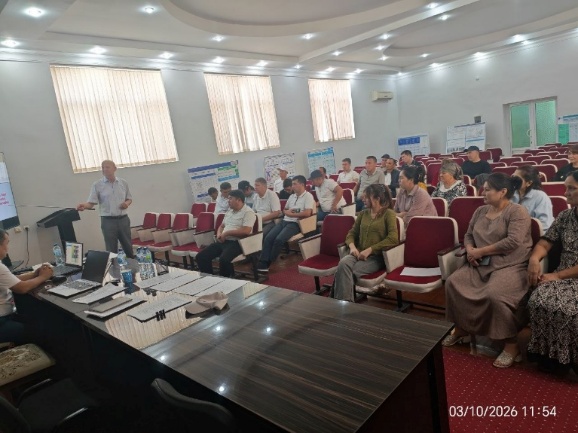
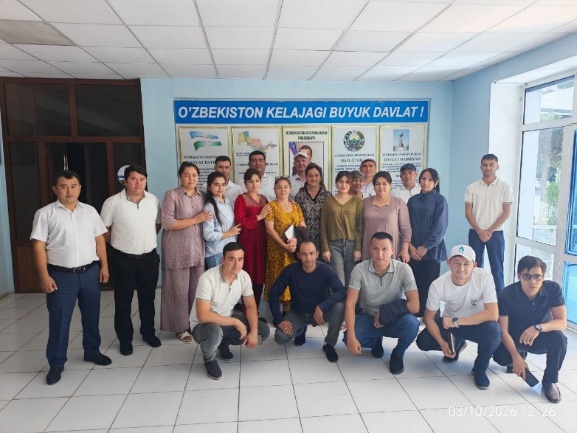
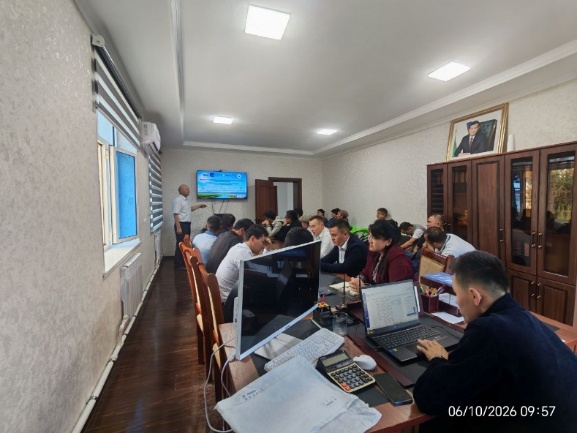
Surkhandarya Region, 28 September 2026. Another round of training sessions dedicated to climate-resilient and sustainable water resources management is currently underway in Surkhandarya Region. The training programme, taking place from 28 September to 9 October, is organised by the Agency for the Implementation of Projects of the International Fund for Saving the Aral Sea (IFAS Agency), in cooperation with the Scientific Research Institute of Irrigation and Water Problems..
The primary objective of the training is to strengthen the up-to-date knowledge and practical skills of specialists working in the water sector of Surkhandarya Region, promote the wider application of rational water use practices, and enhance participants’ capacity to make effective management decisions in the context of climate change. Particular emphasis is placed on combining theoretical knowledge with hands-on practical sessions, sharing participants’ professional experience, and identifying practical solutions to pressing challenges facing the water sector.
The training programme covers key aspects of water use planning and water allocation, water flow measurement and accounting, as well as the operation and maintenance of irrigation networks. In addition, participants explore methods for determining crop water requirements, improving irrigation efficiency, and managing water use under conditions of increasing water scarcity.
Considerable attention is also devoted to current issues concerning the condition of land and water resources. In particular, the programme includes sessions on the physical and chemical properties of soils, assessment of land suitability for irrigation, the causes of soil salinity, drainage system management, water and salt balance, groundwater level monitoring, and water quality assessment.
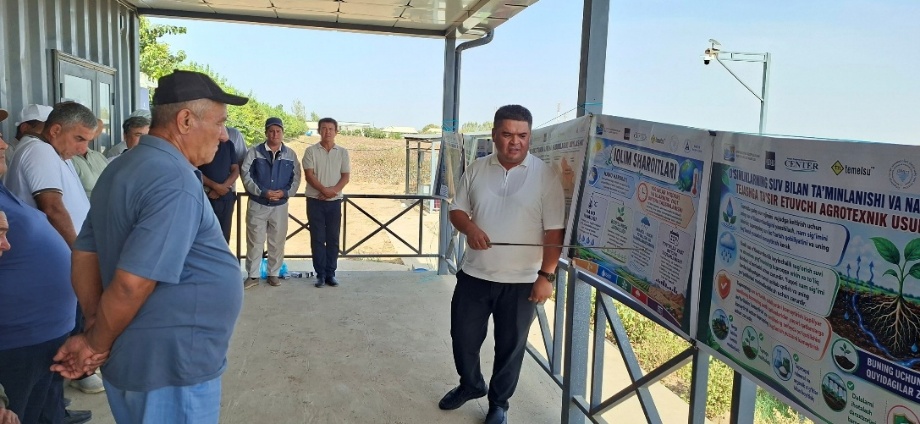
Practical training sessions are an essential component of the programme. Participants develop their skills in using standard water-measuring structures, current meters (hydrometric propellers), and devices such as the Smart Stick. They also learn how to develop water distribution plans and calculate the efficiency coefficient of irrigation networks. Discussions and question-and-answer sessions following individual training modules help consolidate the knowledge acquired and facilitate its practical application.
Alongside specialists from the water management sector, the training sessions are attended by water management specialists from farms and agricultural clusters, as well as mahalla representatives and community activists. For this group of participants, particular attention is given to practical issues such as determining crop water requirements, planning irrigation schedules, measuring water flows, understanding the influence of soil types on crop development, applying water-saving practices, and managing soil moisture and salinity directly under field conditions.
Upon completion of the training, participants’ acquired knowledge and practical skills will be assessed, and the overall training outcomes will be analysed. The programme also includes practical sessions on preparing water and salt balance assessments, evaluating the impact of management interventions on balance indicators, examining international experience in drainage management, and identifying potential management solutions to address existing challenges.
Overall, this latest cycle of training activities aims to strengthen water resources management capacity in Surkhandarya Region, expand the practical knowledge of water sector specialists and water users, and promote improved approaches to water resources management under conditions of climate change and increasing water scarcity. Applying the knowledge and skills acquired during the training will contribute to more efficient water use, improved operation of irrigation systems, and the effective implementation of measures aimed at enhancing the ameliorative condition of agricultural land..