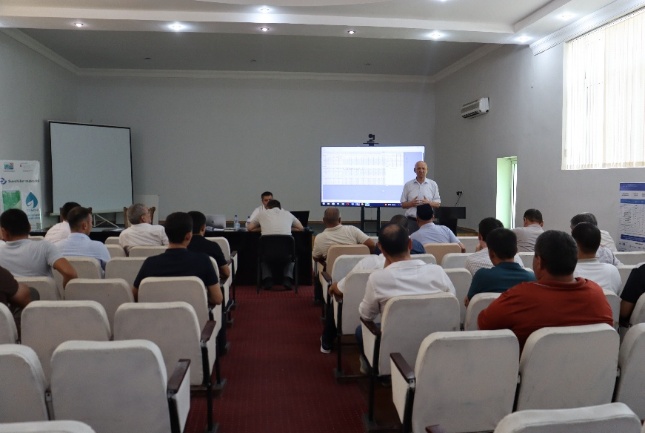
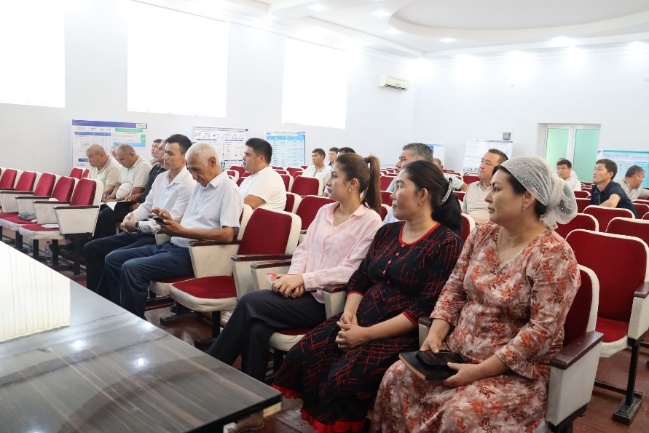
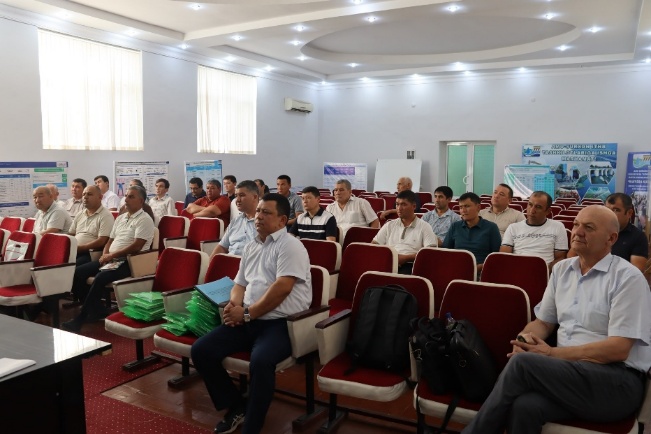
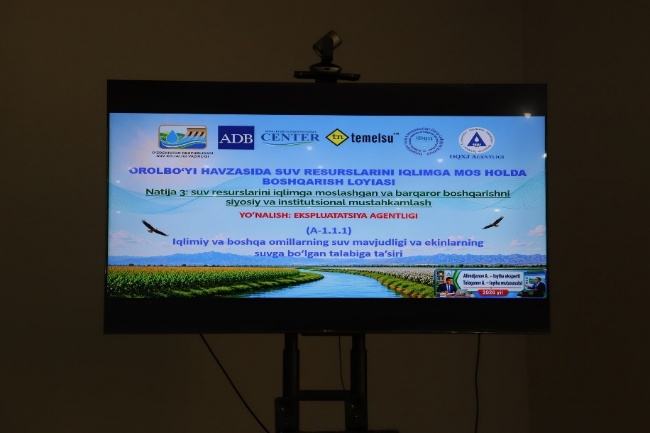
Surkhandarya Region, 18 August 2026. As part of the project “Water Resources Management in the Aral Sea Basin Taking into Account Climate Change”, a new series of training seminars has commenced for water sector specialists in Surkhandarya Region. The seminars are being held from 18 to 22 August and from 24 to 28 August at the premises of the Amu-Surkhan Basin Irrigation Systems Administration.
The main objective of these training activities is to strengthen the professional capacity of water sector specialists in assessing water demand under climate change conditions, ensuring the efficient allocation of water resources, and applying modern approaches to irrigation systems management. Particular attention is also being given to developing practical skills in water accounting and accurate water flow measurement, efficient operation of irrigation infrastructure, and ensuring its proper technical condition.
The training sessions are attended by specialists from the “Amu-Surkhan” Basin Irrigation Systems Administration, Irrigation Systems Administrations, pumping station units, state water delivery institutions, farms, as well as other relevant water sector organisations in the region. The training process includes a preliminary assessment of participants’ existing knowledge, reinforcement of acquired knowledge through discussions and question-and-answer sessions, and a final assessment of the knowledge and skills gained upon completion of the training.
At the initial stage of the training seminars, particular attention is given to water demand assessment and water use planning. The programme covers the impact of climatic and other factors on water availability and crop water requirements, climate change adaptation measures, calculation of irrigation water requirements for crops, irrigation scheduling, and drought management strategies. Practical approaches to developing water use plans at farm level and applying relevant software tools are also considered.
The rational use of water resources largely depends on their proper allocation and accurate accounting. Accordingly, the next part of the training focuses on developing water allocation plans and maintaining water accounts. The programme covers water balance, hydro-module zoning, development of water use plans at the level of main and inter-district canals, management of water allocation under drought conditions, establishment of a database of water users, and preparation of relevant reports. Participants also study methods for using remote sensing data and GIS for monitoring water use and assessing water productivity.
Effective water allocation and accounting, in turn, require accurate measurement of water flows and reliable data. Therefore, modern flow measurement methods occupy a significant part of the programme. Participants enhance their knowledge and practical skills in measuring flows in rivers, canals, and at water intake points; using standard and advanced water measurement instruments; operating and maintaining hydrometric stations; and applying mobile electronic flow meters. Subsequent sessions focus on the operation of flow measurement stations, database management, water resources accounting, and the effective organisation of information exchange.
During the second stage, held from 24 to 28 August, the main focus is on irrigation systems management, operation, and maintenance. In particular, the programme addresses the level and maintenance requirements of irrigated agriculture, the objectives and tasks of operation and maintenance, key performance indicators of irrigation systems, canal management at different levels, and the organisation of pumping station operations.
This area also covers the coordination of pumping stations and pumping units with the water supply requirements of canals, the use of effective communication mechanisms for operational management, compliance with occupational health and safety requirements, emergency management, and the maintenance of irrigation and pumping infrastructure. This contributes not only to strengthening the management capacity of specialists, but also to enhancing their practical skills in ensuring the stable and reliable operation of infrastructure.
For Surkhandarya Region, these training activities are particularly important for improving the efficiency and rational use of water resources, organising water allocation based on accurate calculations, and ensuring the reliable functioning of irrigation systems. Strengthening specialists’ capacity to assess water demand, make optimal management decisions under drought conditions, accurately measure water flows, and apply modern monitoring tools creates a solid foundation for improving the effectiveness of water resources management in the region.
At the same time, the significance of the new knowledge and practical skills developed through the training extends beyond Surkhandarya Region. As an important part of the Amu Darya Basin, the region is interconnected with water resources use and management processes throughout the basin. In this context, improving the accuracy of water accounting, enhancing water allocation, ensuring the efficient operation of irrigation networks, and carrying out timely infrastructure maintenance will contribute to more effective water resources management at the basin level.
Overall, the training activities being conducted in Surkhandarya Region give practical substance to the project’s objectives of promoting adaptive and sustainable water resources management in the context of climate change. The continuous strengthening of specialists’ professional capacity, wider application of modern management and monitoring methods, and enhanced skills in the efficient operation of irrigation infrastructure contribute to increasing the region’s resilience to the impacts of climate change. In turn, this process will support water security and contribute to achieving long-term objectives for the sustainable use of water resources.